


Why Do Japanese Fans Clean the Stands After Matches?
In this article
A football match comes to an end. Thousands of people in the stands get up from their seats and begin heading toward the exits. But some Japanese fans do not leave the stadium immediately.
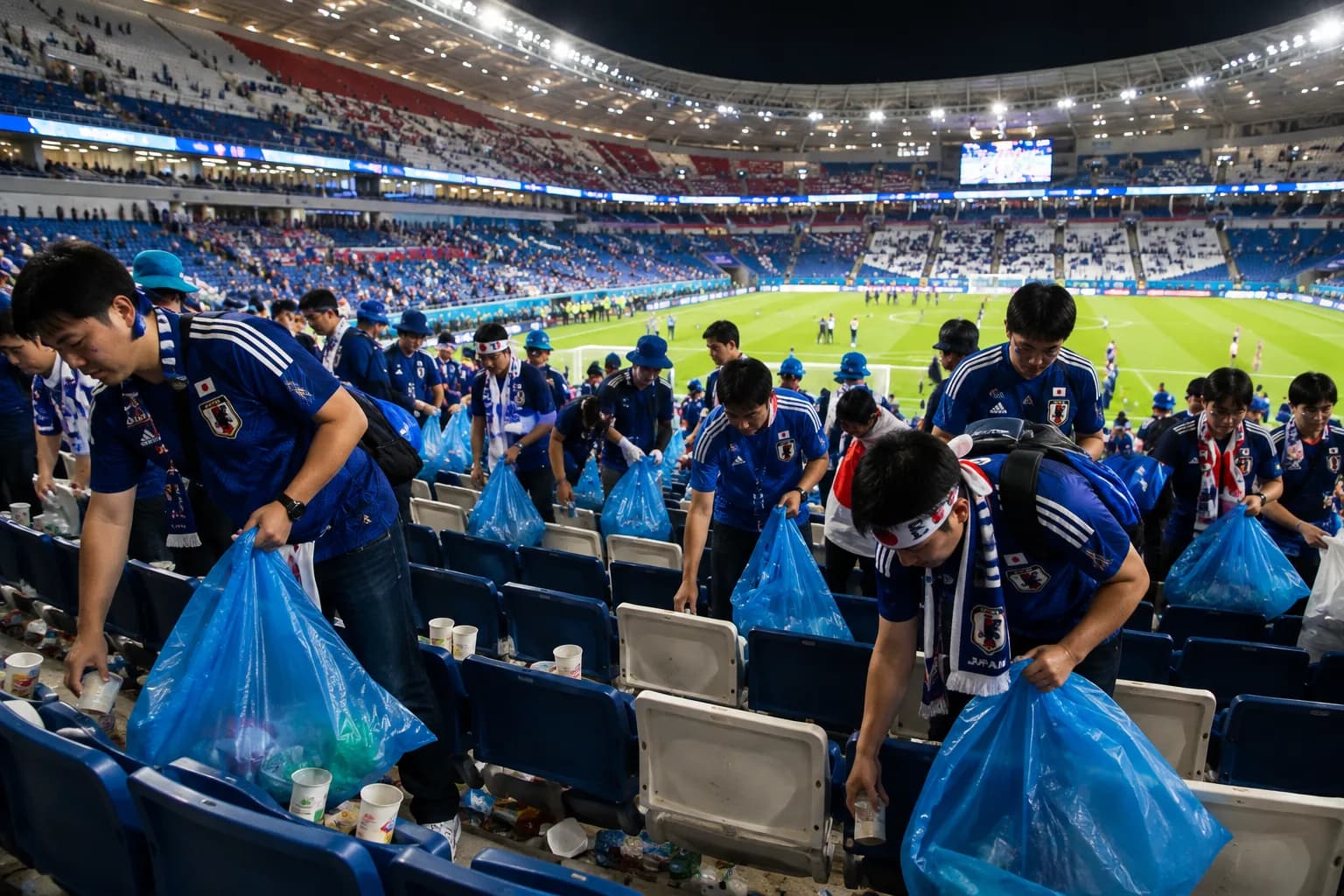
They pick up trash bags and begin collecting cups, food wrappers, and other rubbish from around their seats. These scenes, which frequently attract attention during international tournaments such as the FIFA World Cup, have now become closely associated with Japanese football fans. What is more, this behavior is not seen only after matches Japan wins. FIFA specifically highlighted that even after Japan’s 1-0 defeat to Costa Rica at the 2022 World Cup, fans remained in the stands and collected trash. The same scenes continued at the 2026 FIFA World Cup as well. After Japan’s 2-2 draw against the Netherlands on June 14, 2026, Japanese supporters were seen collecting trash in the stands.
So why do Japanese fans clean the stands after matches? The answer is not as simple as saying, “Japanese people like cleanliness.” Behind this behavior are habits encountered from childhood, such as respect for shared spaces, taking responsibility for the area one uses, and avoiding creating unnecessary burdens for others.
The Habit of Cleaning Begins at School
One of the best ways to understand this behavior in Japan is to look at daily life in schools. In many Japanese schools, students do more than simply attend lessons. At certain times, they also help clean classrooms, corridors, and shared spaces. This practice is generally called sōji (掃除), meaning “cleaning.”
Students may:
- organize desks,
- sweep classrooms,
- clean corridors,
- help keep shared spaces they use in order.
When describing Japanese fans’ cleaning behavior at the 2018 World Cup, FIFA also drew attention to the connection between this habit and the culture of school cleaning in the Japanese education system. One of the aims is to teach children responsibility, respect for others, and awareness of shared spaces. In this way, children encounter a very simple idea from an early age:
“Leave the place you use as clean as possible.”
Years later, the same behavior can appear in stadiums, parks, or other shared spaces.
“Why Should Someone Else Pick Up My Trash?”
Another important idea behind the behavior of Japanese fans is taking responsibility for the mess one creates. Cups, bottles, wrappers, and other trash used during the match are collected afterward. The aim is not simply to make the stadium look tidy. It is also about considering the people who will use the space afterward and the stadium staff. In an article published after the 2018 World Cup, the Japan Football Association also noted that Japanese supporters had attracted international attention for cleaning the stands instead of leaving their trash behind after both victories and defeats.
Respect for Shared Spaces
It would also be inaccurate to view this behavior as a tradition unique to football. In Japan, there is a strong social expectation that shared spaces should be used in a way that does not inconvenience others. Therefore, a stadium seat is not seen merely as a personal space used for a few hours. It is understood that other supporters, staff members, and people attending the next match will also use the same space. For this reason, not leaving the stands in worse condition than when they arrived becomes a natural part of the match experience for some fans.
When Did the World First Notice Japanese Fans?
Japanese fans cleaning the stands is not a new social media trend. According to the Japan Football Association, similar behavior could already be seen in the 1990s, and at the 1998 FIFA World Cup in France, Japan’s first World Cup appearance, Japanese supporters attracted attention by collecting trash from the stands even though the team lost all three of its matches. The behavior later returned to international media attention at different World Cups. During the 2018 FIFA World Cup in Russia, in particular, FIFA highlighted Japanese and Senegalese fans cleaning the stands after matches. Supporters from both countries were among the nominees for the FIFA Fan Award because of their behavior.
The Story Behind the Blue Trash Bags at the 2022 World Cup
One of the most recognizable details in images of Japanese fans cleaning is the blue trash bags. Their story, however, is particularly interesting. During the 2022 FIFA World Cup in Qatar, the Japan Football Association distributed 8,000 blue trash bags to supporters. The original purpose of the bags was for fans to hold them up in the stands and help create the “Samurai Blue” color associated with Japan’s national team. After the match, the same bags were then used to collect trash. Masaya Fukumori, one of the leaders of a Japanese supporter group, explained it quite simply: since they already had the bags with them, they used them to collect trash after the match. The blue bags therefore became more than just a symbol of cleaning; they also provide a good example of support for the team transforming into a practical cleaning tool once the match ends.
Are Japanese Fans the Only Ones Who Clean?
No. Similar behavior can also be seen among supporters from other countries. During the 2018 World Cup, for example, Senegalese fans also attracted considerable attention for collecting trash from the stands after matches. FIFA highlighted the behavior of Japanese and Senegalese fans together. Therefore, it would not be accurate to view cleaning the stands as something unique to Japanese people. However, the fact that Japanese supporters have continued this behavior consistently across different tournaments for many years has led it to become strongly associated with Japanese football culture.
The Players Clean Their Dressing Rooms Too
One striking aspect of this mindset is that it is not limited to the stands. At the 2018 FIFA World Cup in Russia, Japan was eliminated after a dramatic 3-2 defeat to Belgium. Despite this, the dressing room used by the Japanese national team was tidied and cleaned before the players left, and a note reading “thank you” in Russian was left behind. The Japan Football Association later presented this behavior as one example of a culture of “respect.” In other words, the idea is quite consistent:
Leave the place you use in good order and think about the person who comes after you.
Is There a Connection with “Mottainai”?
When Japanese culture is discussed, this behavior is sometimes associated with the concept of mottainai (もったいない). Mottainai roughly expresses regret over waste or over unnecessarily wasting the potential of something. However, explaining Japanese fans’ cleaning of the stands directly as a result of the mottainai tradition would be an oversimplification. Similar values may exist in terms of avoiding waste and treating things with care, but school education, football culture, social responsibility, and respect for shared spaces provide more direct explanations for stadium cleaning.
Is It Related to Shinto Culture?
Cleanliness and purification also have very old historical and religious associations in Japanese culture. Physical and ritual purification are particularly important in the Shinto tradition. Washing the hands and rinsing the mouth with water at shrine entrances is one of the most visible examples. However, it would not be accurate to directly link the modern habit of Japanese fans cleaning the stands to Shinto belief. Today’s behavior is better understood as a combination of education, family habits, sports culture, and social norms.
Is It Mandatory?
No. There is no general rule requiring Japanese fans to clean the stands after matches. Likewise, it would also be inaccurate to say: “All Japanese fans always collect trash after every match.” Those who clean do so voluntarily. Japanese fans interviewed by FIFA at the 2022 World Cup also described the behavior not as an unusual performance, but as a natural habit that had long been seen at J.League matches in Japan.
They Keep Cleaning Even When Their Team Loses
One of the reasons this behavior attracts so much attention worldwide is that it does not depend on the result of the match. Similar scenes appear whether Japan wins or loses. At the 2022 World Cup, supporters collected trash after Japan defeated Germany. Later, when Japan lost to Costa Rica, some fans again stayed in the stands and cleaned. FIFA specifically highlighted these scenes. This shows that the cleaning is less of a victory celebration and more a part of supporter behavior itself.
The Tradition Continues at the 2026 World Cup
The sight of Japanese supporters cleaning the stands has not remained a nostalgic image from past World Cups. The same tradition is continuing at the 2026 FIFA World Cup as well. After Japan’s 2-2 draw with the Netherlands on June 14, 2026, Japanese supporters collected trash in the stands using blue bags. Japan head coach Hajime Moriyasu also described the behavior as one aspect of Japanese culture that the country could be proud of internationally. This suggests that the habit has continued across different generations of Japanese football supporters for nearly three decades.
Being a Fan Is About More Than Just Cheering
Japanese football supporters are just as colorful and enthusiastic as fans in other parts of the world. Flags, chants, songs, and organized supporter groups are all important parts of Japanese football culture. For some fans, however, being a good supporter is not simply about backing their team for 90 minutes. Showing respect for the stadium, its staff, and fellow spectators is also part of the experience. For this reason, staying in the stands for a few extra minutes after the match and collecting nearby trash becomes a simple yet powerful act.