



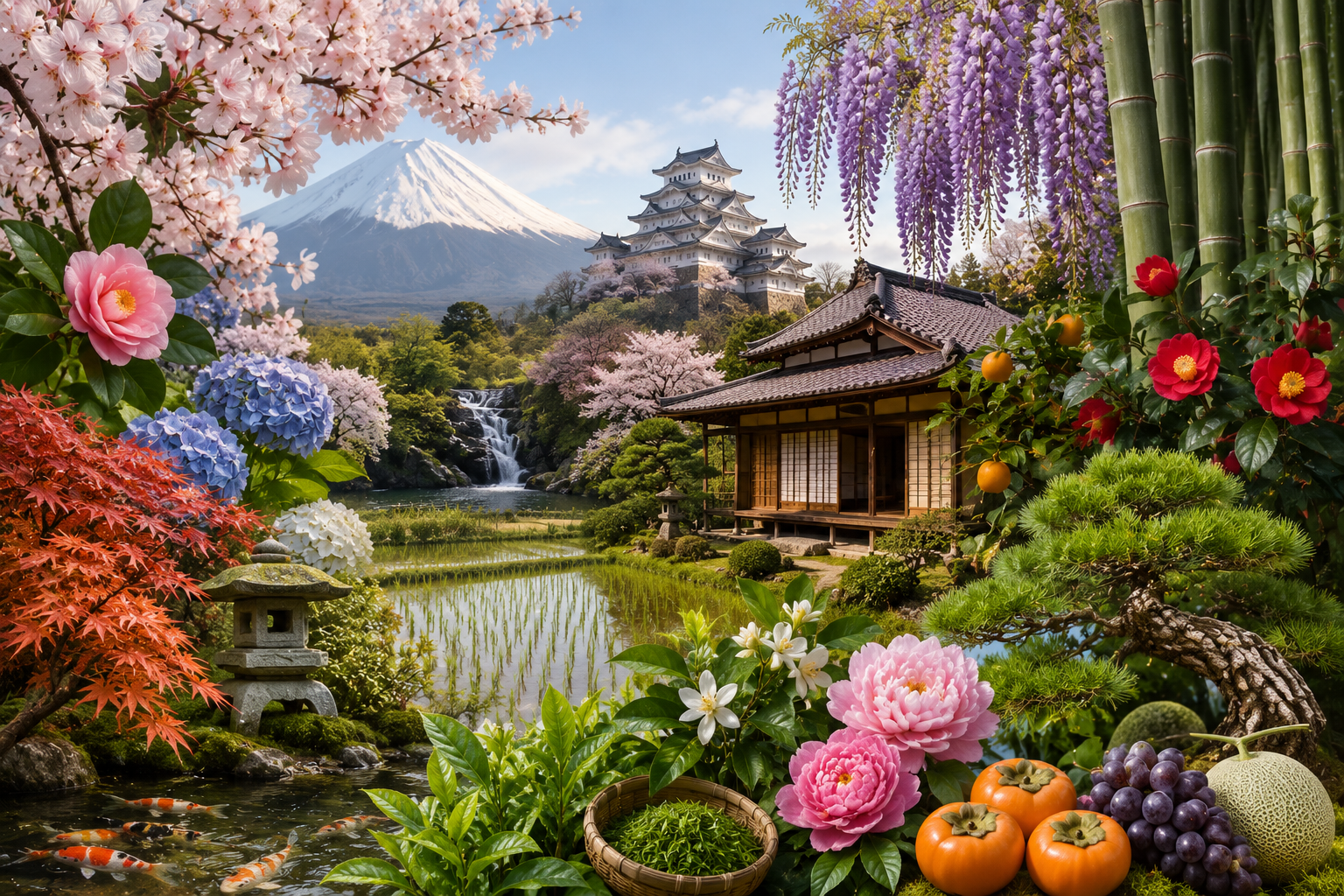
Japan is home to an incredible diversity of plants thanks to its geography, which stretches from north to south, and its clearly defined four seasons. From the cool forests of Hokkaido to the tropical coasts of Okinawa, this wide landscape supports many plants that have become symbols of Japanese culture and an inseparable part of daily life.
In this article, you will discover some of the important plants that shape Japan’s natural landscape, along with their cultural meanings.
What image comes to mind first when you think of Japan? Most likely, it is pink petals drifting through the air and rows of sakura trees. Cherry blossoms are not merely a botanical species; they are a concrete expression of the Japanese philosophy of life, respect for impermanence, and the deep bond between people and nature.
Every spring, people across Japan fill parks, riversides, and historic sites for the flower viewing tradition known as hanami. This short but enchanting blooming period turns into an almost festive season throughout the country.
Japan’s tea culture dates back centuries and has become a world renowned cultural heritage today. Matcha, sencha, and gyokuro, all produced from the same plant through different processing methods, are three important representatives of the Japanese tea tradition.
Tea fields are often found in the country’s mountainous and humid inland regions. In particular, rows of tea plantations spread across mist covered green hills create one of Japan’s most iconic landscapes.
Bamboo stands out in Japan both as a natural plant and as a cultural symbol. Known for its durability and rapid growth, bamboo appears in many areas of Japanese life, from traditional architecture and everyday tools to art and garden design.
The Arashiyama Bamboo Grove in Kyoto is a world famous natural attraction that draws millions of visitors every year. Walking among the unique sounds and shades of green created by the bamboo stalks is truly an unforgettable experience.
In Japan, autumn is welcomed with almost as much excitement as the cherry blossom season. During this period, known as koyo, the leaves of maple, beech, and oak trees turn into rich shades of red, orange, and yellow.
Just as hanami is the tradition of spring, momijigari is the tradition of autumn. People go out into nature to admire this colorful transformation, take photos, and experience this brief yet magnificent seasonal change together.
Wasabi, perhaps the most famous condiment in Japanese cuisine, is actually a plant that grows only under very delicate conditions and is extremely difficult to cultivate. Real wasabi grows near cool running water and has a much more complex and mellow flavor profile than the tube versions commonly found in supermarkets.
Fresh wasabi root is slowly grated with a fine wooden grater called an oroshi and served alongside sushi or sashimi. Its aroma reaches its peak within a short time after being grated.
Although it is often confused with sakura, the Japanese cherry is a distinct species and an essential part of Japanese garden culture. With its delicate and elegant blossoms, it is commonly seen in traditional Japanese gardens, temple courtyards, and park landscapes.
In Japan, you gradually realize that a plant is never just a “plant.” Sakura represents impermanence. Bamboo symbolizes flexibility and strength. Tea becomes a practice of stillness, awareness, and quiet reflection.
These plants are concrete reflections of Japanese aesthetics, the philosophy of wabi-sabi, and the delicate balance between people and nature. Learning about these plants before visiting Japan provides a strong foundation not only for seeing the country, but also for truly feeling it.