


The Healing Power of Nature: Japan’s “Shinrin-Yoku” (Forest Bathing) Movement
In this article
Busy city life, crowds, screens, and the constant rush of everyday routines… The pace of modern life is gradually reducing the amount of time people spend in nature. Japan, however, has long practiced a simple yet effective way of reconnecting with the natural world: Shinrin-Yoku, or forest bathing.
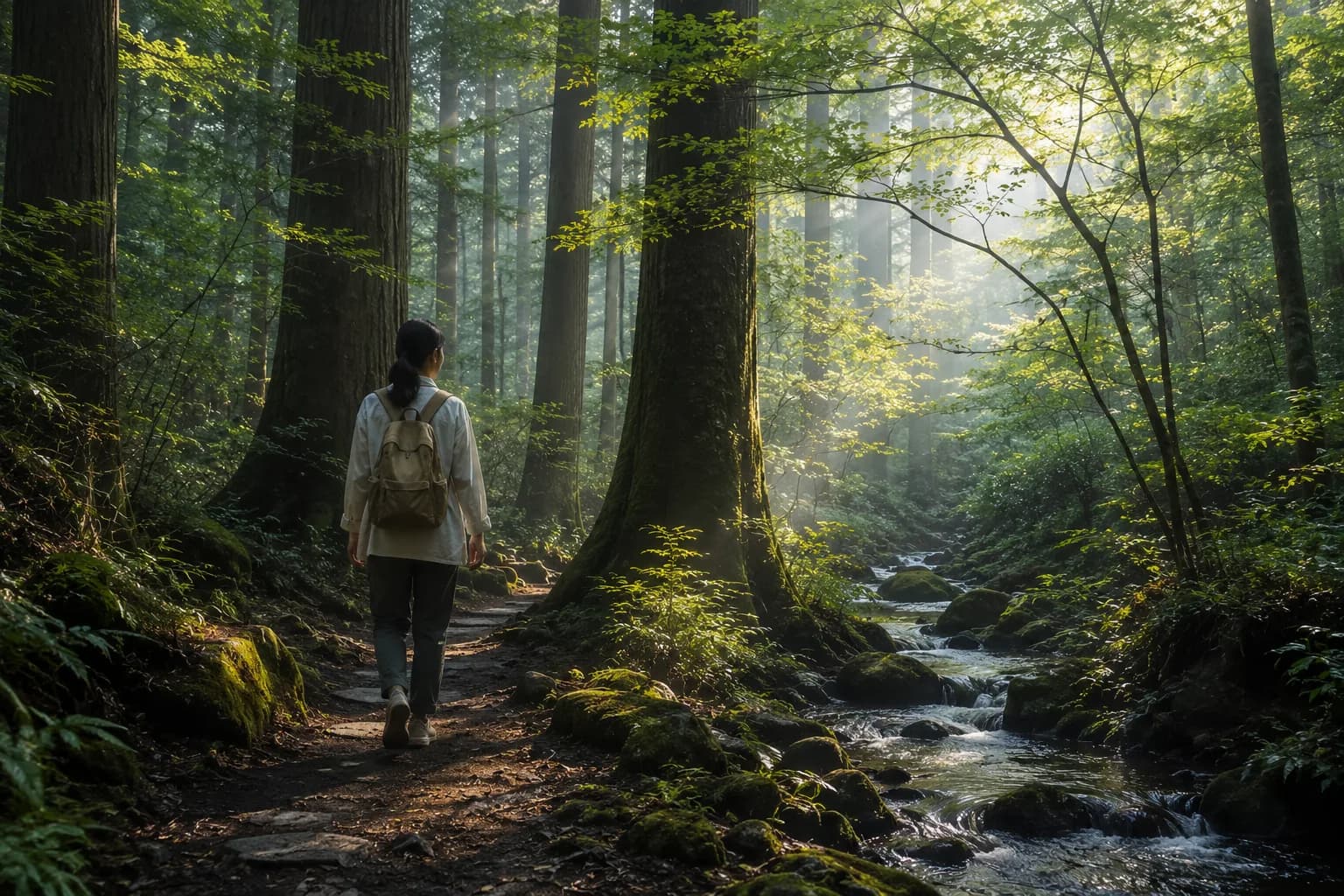
Although the word “bathing” appears in its name, Shinrin-Yoku has nothing to do with water. At the heart of this practice is spending time in the forest, listening to the surrounding sounds, noticing the scent of the trees, and experiencing nature through all the senses.
What Is Shinrin-Yoku?
In Japanese, “shinrin” (森林) means forest, while “yoku” (浴) refers to bathing or immersing oneself in something. For this reason, Shinrin-Yoku is generally translated as “forest bathing.” The concept was introduced by the Japan Forestry Agency in 1982 as an approach intended to encourage people to develop a closer connection with forests. Today, under the name “Shinrin-Yoku,” the practice has spread beyond Japan and become known in many countries around the world. The purpose of Shinrin-Yoku is not to walk long distances through the forest, exercise, or reach a particular destination. The main goal is to slow down and consciously experience the atmosphere of the forest.
How Is Forest Bathing Practiced?
Shinrin-Yoku does not require special equipment or a challenging trail. Spending time in a quiet, natural forest environment is enough.
During forest bathing, people generally:
- Stay away from phones and other digital devices.
- Move slowly rather than walking quickly.
- Listen to birds, leaves, and the wind.
- Notice the scent of trees and soil.
- Observe the colors and changing light in the surroundings.
- Try to remain in the present moment as much as possible.
- Occasionally stop and simply experience the environment.
The key point here is actively using all five senses. Rather than merely looking at the forest, noticing its sounds, scents, textures, and atmosphere lies at the heart of the Shinrin-Yoku experience.
Why Did Shinrin-Yoku Emerge in Japan?
Japan, particularly in major cities such as Tokyo, Osaka, and Yokohama, has an extremely busy and fast-paced daily lifestyle. Long working hours, crowded public transportation systems, and the central role of technology in everyday life have made time spent in nature increasingly valuable. Shinrin-Yoku developed in this context as an approach that reconnects people with natural environments. However, forming strong connections with nature is nothing new in Japanese culture. Mountains, trees, rocks, and natural formations hold an important place particularly in Shinto culture. Traditions such as observing seasonal changes, viewing cherry blossoms, or admiring autumn leaves are also different examples of the Japanese relationship with nature. For this reason, although Shinrin-Yoku emerged within modern life, it is highly compatible with Japan’s long standing cultural approach to nature.
What Are the Benefits of Shinrin-Yoku?
Over time, forest bathing has also attracted the attention of scientists, and numerous studies have examined the effects of spending time in nature on people. Field studies carried out in 24 different forests in Japan observed that forest environments were associated with positive changes in certain indicators of stress and physiological relaxation compared with urban environments. Research on Shinrin-Yoku has particularly examined its relationship with the following areas:
· May Help Reduce Stress: Walking in a quiet forest provides a temporary escape from the traffic, crowds, and constant stimulation of city life. Research suggests that forest environments may be associated with relaxation and lower indicators of stress.
· May Support Mental Relaxation: The psychological effects of forest bathing, not only its physical effects, have also been studied. Research indicates that spending time in nature may have positive effects on feelings of calmness and mood.
· May Be Associated with Changes in Heart Rate: A systematic review and meta analysis published in 2026 found that Shinrin-Yoku practices were associated in the short term with reduced heart rate, as well as improvements in certain psychological measures such as tension and anxiety. However, researchers also emphasize that the available scientific evidence remains limited.
For this reason, rather than viewing Shinrin-Yoku as a treatment for illness, it is more appropriate to consider it a complementary well being practice that supports contact with nature and relaxation in everyday life.
Is Shinrin-Yoku a Form of Meditation?
Although Shinrin-Yoku and meditation share some similarities, they are not the same practice. Meditation usually places greater emphasis on breathing, thoughts, or a specific point of focus, whereas in Shinrin-Yoku, a person’s attention is directed toward the natural environment around them. Listening to a bird, feeling the wind against your face, or watching sunlight filter through the trees can all be part of the practice. For this reason, Shinrin-Yoku can be described as “the practice of consciously being present in nature.”
Do You Have to Go to Japan to Practice Shinrin-Yoku?
Of course not. Although Shinrin-Yoku originated in Japan, the foundation of the practice is not being in a specific Japanese forest, but consciously connecting with nature. A forest, grove, or densely wooded park can all be suitable for Shinrin-Yoku. What matters is not turning the walk into a form of exercise or a journey toward a particular goal, and instead experiencing the surroundings through as many senses as possible. For example, during a short Shinrin-Yoku experience, you can put your phone on silent, slow down your walking pace, and spend several minutes simply listening to the sounds around you. You can then pay attention to the texture of the trees, the scent of the soil, and the small details in the surrounding environment.
Another Way of Connecting with Nature in Japanese Culture
One reason Shinrin-Yoku has attracted worldwide interest may be its remarkable simplicity. It does not require technology, special equipment, or complicated rules. All that is needed is a forest, some time, and the willingness to truly notice your surroundings. It is also quite meaningful that Japan, one of the world’s most technologically advanced countries, developed an approach that reminds people to return to nature.
Shinrin-Yoku reminds us that sometimes we do not need to do more in order to relax; instead, slowing down a little, putting the phone aside, and walking quietly among the trees may be enough.