

Japanese Lucky Cat: What Is Maneki-neko and What Does It Mean?
In this article
At the entrance of a Japanese restaurant, beside the cash register of a small shop, or at a traditional temple, you may come across an adorable cat figurine with one paw raised in the air. This figure is Maneki-neko, one of the most recognizable symbols of Japanese culture around the world.
Commonly known as the “lucky cat,” Maneki-neko is a traditional good luck figure believed to invite fortune, prosperity, customers, wealth, and favorable opportunities.
This charming cat, which has spread from Japan to many different countries, is believed to carry different meanings in numerous details, from which paw it raises to its color.
What Does Maneki-neko Mean?
The Japanese word 招き猫(まねきねこ / maneki-neko) consists of two parts:
招き – Maneki: To invite, to beckon
猫 – Neko: Cat
Therefore, Maneki-neko can be translated as “beckoning cat” or “inviting cat.” The figure’s most characteristic feature is its raised paw.
However, this gesture is not actually a waving motion, as many people assume. In the traditional Japanese beckoning gesture, the hand is raised with the palm facing downward, and the fingers move inward to call someone closer. The raised paw of Maneki-neko represents this gesture.
What Does Each Raised Paw of Maneki-neko Mean?
Some Maneki-neko figures raise their right paw, while others raise their left.
Traditionally:
Maneki-neko with its left paw raised: It is believed to invite people or customers.
Maneki-neko with its right paw raised: It is believed to attract money, prosperity, and financial luck.
For this reason, Maneki-neko figures with their left paws raised are especially common in businesses such as restaurants and shops. Some modern designs raise both paws at once. These are generally considered decorative interpretations representing wishes for both good luck and prosperity.
Where Did Maneki-neko Originate?
There is no single universally accepted story explaining exactly where or how Maneki-neko originated. However, the figure is known to have emerged in Japan during the Edo period. The Edo-Tokyo Museum also describes Maneki-neko as one of the good-luck figures that originated in Edo. Several different legends attempt to explain its history. One of the most famous is associated with Gōtoku-ji Temple in Tokyo’s Setagaya district.
The Famous Maneki-neko Legend of Gōtoku-ji
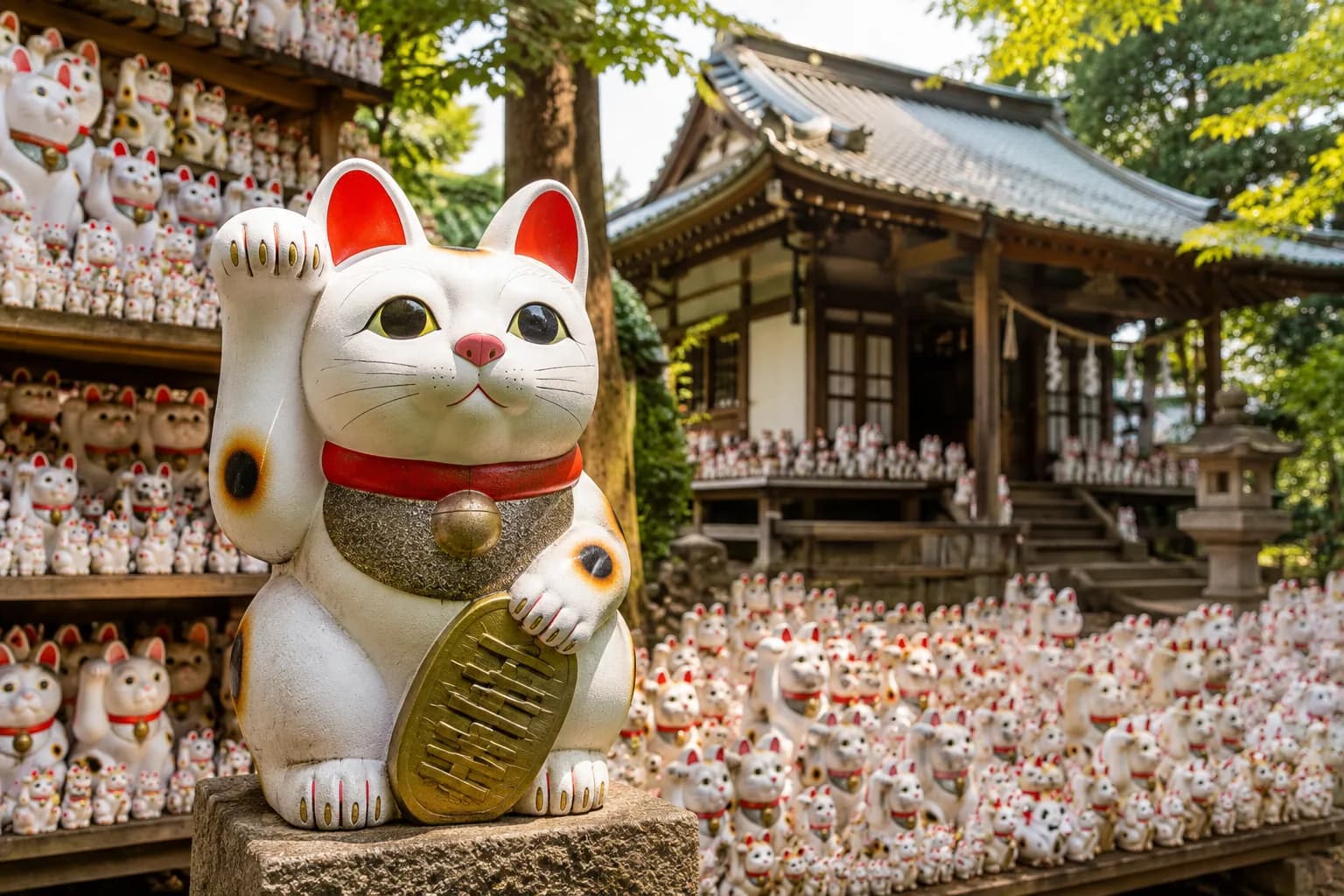
According to legend, during the Edo period, Ii Naotaka, lord of the Hikone domain, was passing through the area where Gōtoku-ji stands while returning from falconry. A cat at the entrance of the temple raised its paw as if beckoning him inside. Naotaka noticed the cat and entered the temple. Soon afterward, thunder began and heavy rain started to fall. By entering the temple, he was sheltered from the storm. Naotaka interpreted this event as good fortune brought to him by the cat. He later supported the temple, and Gōtoku-ji was rebuilt in 1633. Over time, a special area was established at the temple in memory of the cat believed to bring good fortune. Today, visitors to Gōtoku-ji can see the impressive sight of hundreds, and at times even thousands of white Maneki-neko figures gathered together.
Why Don’t the Cats at Gōtoku-ji Have Gold Coins?
Many Maneki-neko figures seen today hold or display a gold colored coin. However, the traditional Maneki-neko figures at Gōtoku-ji do not have this coin.
According to the temple’s own explanation, there is an important idea behind this: Maneki-neko does not directly give a person wealth or happiness, but instead brings opportunities to encounter people and favorable circumstances. It is then up to the individual to make use of those opportunities. This interpretation gives Maneki-neko a meaning that is quite different from simply viewing it as a “cat that brings money.”
Maneki-neko Colors and Their Meanings
Traditional Maneki-neko figures are usually white or inspired by the three colored “mike” pattern commonly seen in Japanese cats. Over time, however, many different color variations of Maneki-neko have appeared.
Today, they are commonly associated with the following meanings:
· White Maneki-neko: Associated with purity, good fortune, and positive new beginnings. It is one of the most classic Maneki-neko colors.
· Gold Maneki-neko: Associated with wealth, money, and financial prosperity.
· It is particularly common in businesses.
· Black Maneki-neko: Believed to represent protection from bad luck or negative influences.
· Red Maneki-neko: Associated with wishes for health and protection.
· Pink Maneki-neko: One of the more modern variations, associated with love and romantic relationships.
· Green Maneki-neko: In some modern interpretations, associated with education, safety, or success.
However, it is important to remember that the meanings attributed to Maneki-neko colors can vary depending on the region, manufacturer, and modern interpretations. Therefore, it would not be accurate to speak of a single, fixed symbolism for every color.
What Is the Gold Coin Held by Maneki-neko?
Many Maneki-neko figures have an oval shaped gold colored coin placed in front of them. This object is inspired by old Japanese gold coins called koban (小判), which were used during the Edo period. In modern Maneki-neko designs, the koban generally symbolizes financial prosperity and abundance.
For this reason, the koban detail is especially common on gold colored Maneki-neko figures designed for businesses.
Where Is Maneki-neko Used?
In Japan, Maneki-neko figures are especially common in businesses.
In Restaurants and Shops: A Maneki-neko placed near the entrance or beside the cash register is believed to invite customers and business fortune.
In Homes: Maneki-neko figures used in homes generally represent wishes for good luck, peace, or prosperity.
At Temples: At certain temples strongly associated with Maneki-neko, such as Gōtoku-ji, the figure’s religious and folkloric aspects are more prominent. Visitors to the temple’s Shōfuku-den hall pray for their families’ well-being, business success, good fortune, and happiness.
Where Can You See Maneki-neko in Japan?
One of the most famous places for those who want to experience Maneki-neko culture up close is undoubtedly Gōtoku-ji Temple in Tokyo. However, it is not the only destination.
For example, Tokoname in Aichi Prefecture is one of Japan’s major ceramic production centers and is also known for producing Maneki-neko. Along the famous Maneki-neko Street, visitors can see numerous different cat figures. In Seto City, also in Aichi, there is the Maneki-Neko Museum, which focuses on Maneki-neko culture. The museum introduces visitors to the figure’s approximately 150 year history and its various design traditions.
From Tradition to Popular Culture: Maneki-neko
Maneki-neko is no longer simply a traditional ceramic figure. Today, this charming cat can be found on keychains, bags, stationery, toys, jewelry, phone accessories, manga and anime designs, and even digital stickers. The worldwide recognition of a figure that originated in traditional Japanese culture has made Maneki-neko one of Japan’s most easily recognizable popular culture symbols.
Maneki-neko: A Small Japanese Symbol That Beckons Good Fortune
With one paw raised as if calling people closer, Maneki-neko may at first appear to be nothing more than a cute cat figurine. Yet behind it are stories stretching back to the Edo period, temple legends, commercial traditions, and symbolic meanings associated with good fortune in Japanese culture.
Perhaps this is exactly why Maneki-neko has remained popular for centuries.
招き猫 – Maneki-neko: The cat that invites good fortune, people and new opportunities.