



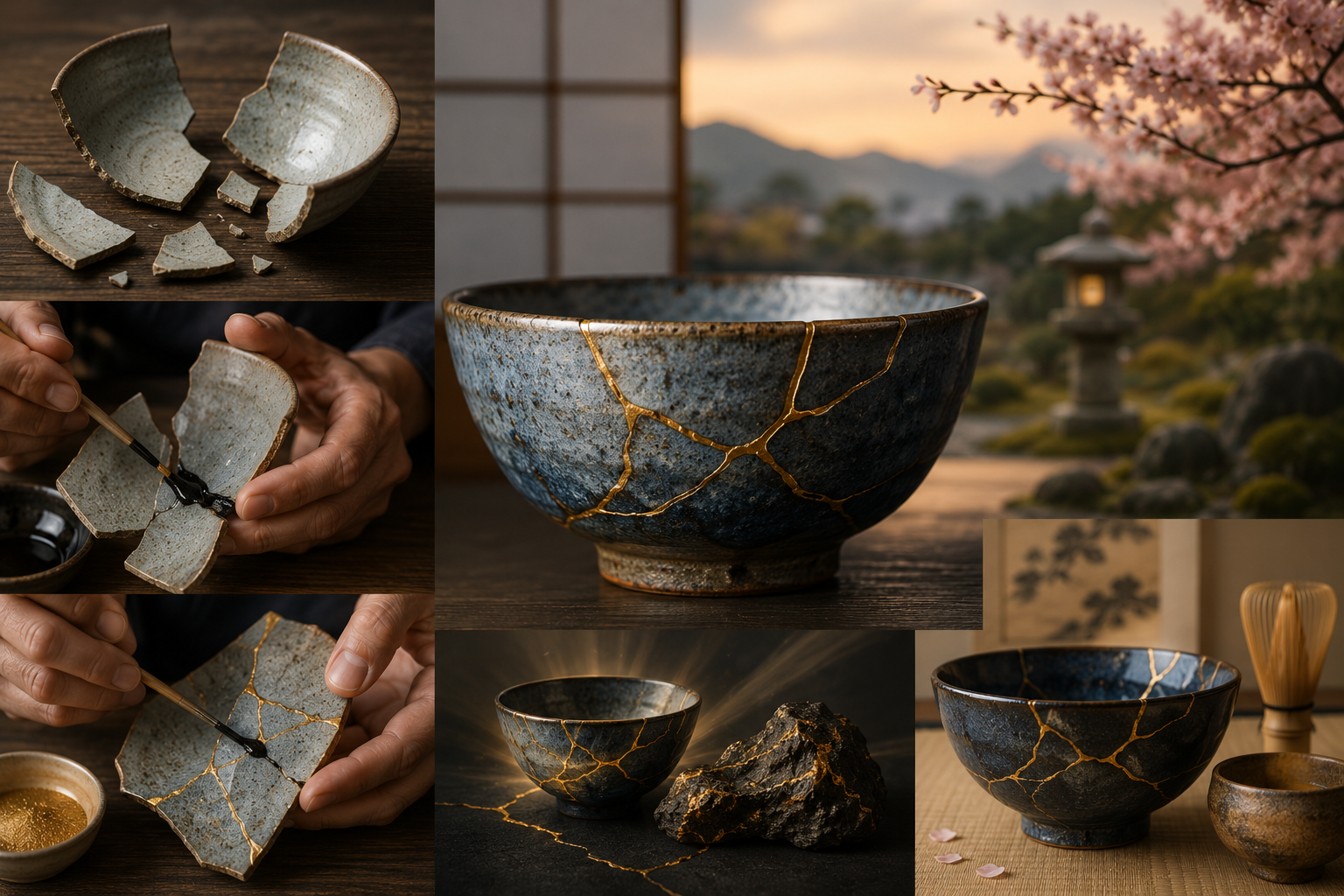
This technique, created by Japanese artisans centuries ago, is now spreading around the world as both a craft and a philosophy of life.
Imagine you have an object that is precious to you. One day, it falls and breaks. Instead of throwing it away or repairing it in a way that hides the damage, what if you highlighted the cracks with gold? The object would become more beautiful and meaningful than ever before. This is exactly what kintsugi is. Behind this simple idea lies a history of more than five hundred years.
In the late 15th century, the Japanese shogun Ashikaga Yoshimasa was deeply disappointed when his beloved tea bowl broke. He sent the bowl to China to be repaired, but it came back fixed with metal staples and looked rather unattractive. This rough repair did not fit the Japanese sense of aesthetics.
In response, Japanese craftsmen began searching for an answer to a different question: instead of hiding the cracks, could they be made beautiful? The answer came from the combination of natural lacquer called urushi and real gold powder. The broken lines were no longer concealed; instead, they were emphasized. This is how kintsugi, meaning “joining with gold,” was born.
A true kintsugi repair is not something that can be completed quickly. Traditional artisans sometimes spread the process over more than six months. The basic steps are as follows:
What separates kintsugi from an ordinary repair technique is the way of thinking behind it. Two deeply rooted concepts in Japanese aesthetics form the foundation of this philosophy.
The first is wabi-sabi, which finds beauty in what is imperfect, incomplete, and temporary. Perfection is not seen as the ultimate goal; rather, it can be viewed as something sterile and emotionally distant. The second is mono no aware, which expresses the sadness of impermanence and the quiet acceptance that comes with it. When an object breaks, it becomes proof that the object has lived.
When these two ideas meet in kintsugi, they deliver a powerful message: there is no need to hide your past. Every break you have experienced makes you more complex and more valuable.
Over the past decade, kintsugi has gained increasing attention in the worlds of psychology, personal development, and art. It is fair to say that this is no coincidence. In a world where perfectionism is often presented as a virtue and every crack is expected to be hidden, kintsugi says the exact opposite: allowing weaknesses to be visible is an act of courage.
Therapists use this metaphor to explain healing after trauma. Artists intentionally create cracks and repair them. In workshops around the world, from Istanbul to Tokyo and from London to São Paulo, people learn how to repair old bowls and plates. But in reality, they are also learning a new way of seeing things.
Perhaps the most powerful lesson kintsugi teaches us is that a repaired object can be stronger than one that has never been broken. When gold fills the cracks and hardens, the joined areas can often become more durable than the original material. This is not only a physical fact, but also a powerful metaphor.
The next time you hold a broken object in your hands, you may want to pause for a moment before throwing it away. Kintsugi asks you this: does this crack not tell a story?