



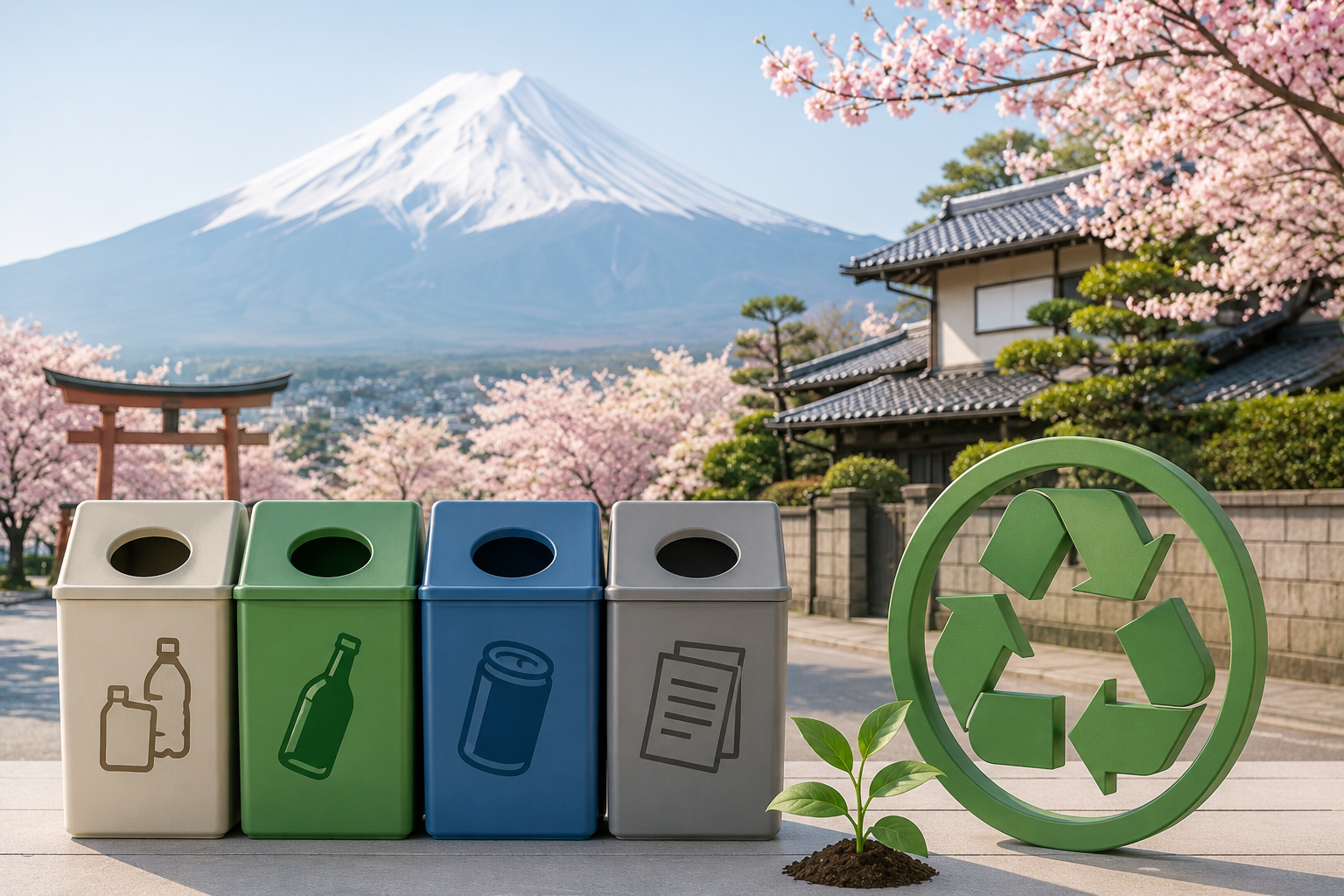
The Development of Waste Recycling in Japan
Due to its limited natural resources, densely populated cities, and restricted usable land, Japan has long treated waste management as an important environmental policy issue. Today, recycling in Japan does not simply mean processing waste into new materials; it is part of a broader approach focused on reducing waste generation, reusing products, recycling materials, and keeping resources within the economic cycle for as long as possible.
At the center of this approach is the 3R principle that Japan has promoted for many years:
Reduce: Reducing waste before it is generated
Reuse: Making further use of products that can still be used
Recycle: Turning waste back into raw materials or resources
Japan’s transformation in waste management has largely developed around these three principles.
From a Waste Problem to a Sound Material Cycle Society
During Japan’s rapid economic growth in the 1950s and 1960s, increasing production and consumption created serious waste problems, particularly in major cities. Growing amounts of garbage, limited landfill capacity, and environmental pollution made it necessary for the country to establish a more comprehensive waste management system.
Over time, Japan moved away from a system focused solely on collecting and disposing of waste toward a model aimed at recovering and reusing resources. Particularly from the 1990s onward, various laws were introduced to regulate the recycling of specific product categories.
The Containers and Packaging Recycling Law, enacted in 1995, became one of the major regulations governing the sorting and recycling of packaging waste. The Home Appliance Recycling Law, enacted in 1998 and implemented in 2001, more clearly defined the responsibilities of manufacturers, retailers, and consumers for the collection and recycling of certain electronic appliances, including televisions, air conditioners, refrigerators, and washing machines.
From the 2000s onward, the objective expanded beyond recycling itself toward the creation of a broader “sound material cycle society.” Preventing waste from being generated in the first place therefore became just as important a policy goal as recycling.
Waste Sorting as Part of Everyday Life
One of the most distinctive features of Japan’s system is the emphasis placed on sorting waste at its source.
Although rules and categories vary between municipalities, household waste can generally be divided into categories such as burnable waste, non burnable waste, plastics, PET bottles, glass bottles, metal cans, paper, and cardboard.
In some areas, bulky waste and electronic appliances are handled through procedures completely separate from ordinary household waste collection. Residents need to keep track of which types of waste should be put out on which days and according to which procedures.
This system does more than simply make waste collection easier for municipalities. Correctly sorting waste at home prevents recyclable materials from becoming mixed with other waste and makes subsequent processing easier. Japan’s waste policies also place responsibility on consumers to help reduce the amount of waste they generate and to sort it correctly.
Producer Responsibility for Electronic Waste
One of the important systems developed in Japan concerns the recycling of electronic appliances.
Under the Home Appliance Recycling Law, retailers play an important role in collecting certain used electronic products, while manufacturers are responsible for their recycling. The aim is to recover materials such as metals, plastics, and glass contained in electronic appliances and return them to the economy.
This approach is significant because responsibility for waste is not placed solely on the consumer who uses the product. Instead, the system seeks to address the entire product lifecycle, from production to the end of its useful life.
A New Era for Plastic Waste
In recent years, plastic waste has become one of the areas receiving particular attention in Japan.
The Plastic Resource Circulation Act came into effect on April 1, 2022. Rather than treating plastics solely as a waste problem that emerges after use, the legislation adopts a lifecycle approach covering product design, production, use, collection, and recycling.
Under the law, municipalities are encouraged to develop systems for sorting and recycling not only plastic packaging but also various plastic products. Voluntary collection of their own products by manufacturers and their participation in recycling processes are also important parts of the system.
This demonstrates Japan’s efforts to transform its traditional 3R approach into a more comprehensive circular economy model.
Is All Waste in Japan Recycled?
Because of Japan’s highly developed waste sorting system, it may be easy to assume that a very large proportion of the country’s waste is directly recycled. However, the actual picture is somewhat different.
According to fiscal year 2024 data from Japan’s Ministry of the Environment, a total of 7.38 million tons of municipal waste was recycled, resulting in a recycling rate of 19.3%. During the same period, the amount of waste sent for final disposal fell to approximately 3.06 million tons.
One important reason is Japan’s extensive use of waste incineration facilities. Because land and final disposal capacity are limited, reducing the physical volume of waste is particularly important. Japan therefore also uses advanced waste incineration and energy recovery systems as an important part of its waste management strategy.
Japan’s performance therefore cannot be evaluated solely through its “recycling rate.” Waste reduction, sorting systems, reuse, energy recovery, and the reduction of waste sent to landfill all need to be considered together.
Social Participation Is as Important as Technology
Technology and legislation are important to Japan’s waste management system, but public participation also plays a major role.
Before a product can reach a recycling facility, it must first be sorted correctly. For this reason, municipal collection schedules and waste sorting rules have become part of everyday life.
At the same time, choosing reusable products, reducing unnecessary packaging, and giving usable items a second life through second hand systems are all part of the broader effort to prevent waste from being generated in the first place.
From Recycling to a Circular Economy
Looking at the evolution of Japan’s waste policies over the years reveals a significant transformation.
Initially, the primary objective was to dispose of generated waste safely. Over time, the focus shifted toward recycling, followed by the 3R approach, and today toward the concept of a circular economy.
The current objective is not simply to recycle a product after it has been thrown away. Instead, the goal is to develop products that use fewer resources from the design stage onward, can be used for longer periods, can be reused, and can eventually be returned to the economic system at the end of their useful lives.
Initiatives such as the Japan Partnership for Circular Economy (J4CE), promoted by Japan’s Ministry of the Environment to strengthen cooperation between the public and private sectors, also demonstrate the country’s efforts to move beyond recycling toward a broader circular economy model.
Japan’s progress in recycling cannot be explained solely as a success story driven by technological investment. It is the result of a long term transformation combining legislation, municipal sorting systems, producer responsibility, consumers’ everyday habits, and new technologies.
Japan’s experience highlights one particularly important point: Sustainable waste management does not begin with recycling waste after it has been created, but with generating as little waste as possible in the first place.
Today, Japan continues to develop its traditional 3R approach through new regulations covering the entire lifecycle of plastics and broader circular economy initiatives. For this reason, Japan’s experience remains a noteworthy example of how societies that consume fewer resources and generate less waste may be developed in the future.