
Japan’s System of Governance: An Overview of State Institutions and the Political System

Japan’s System of Governance: An Overview of State Institutions and the Political System

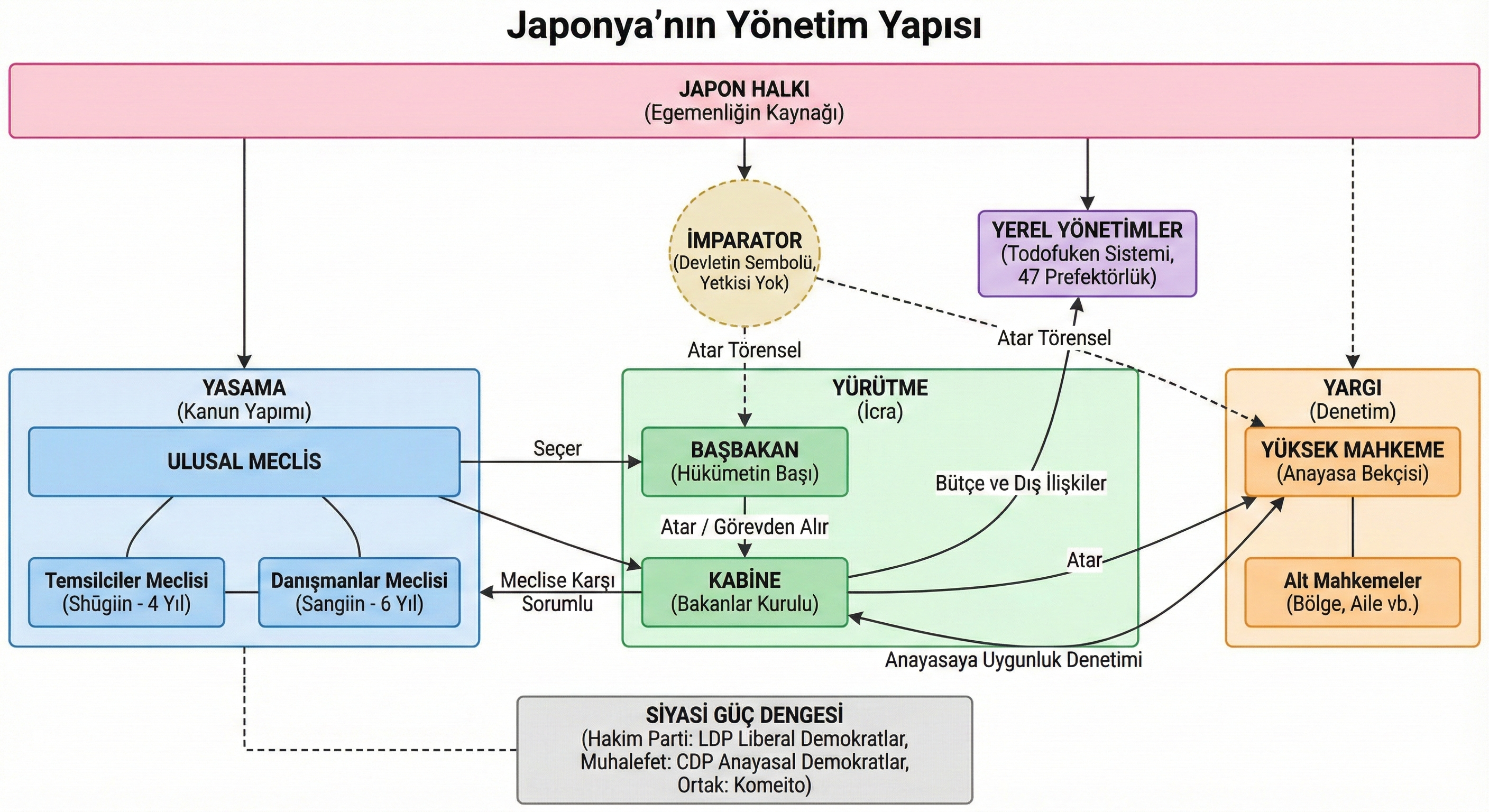
Japan is governed under a constitutional monarchy that blends ancient traditions with modern democratic principles. Shaped by the 1947 Constitution adopted after World War II, this system is based on the principle of separation of powers. The balance between the legislative, executive, and judicial branches forms the foundation of the country’s political stability.

Below is a detailed overview of Japan’s government institutions and administrative dynamics:


  1. Core Dynamics of the Political System

Japan’s political structure rests on two main pillars:

  • Symbolic Monarchy: The Emperor of Japan is defined as “the symbol of the State and the unity of the people.” He holds no political authority or decision making power; all duties are ceremonial (e.g., appointing the Prime Minister, opening the Diet). Sovereignty resides entirely with the people.
  • Parliamentary Democracy: The country is governed by a parliament (the Diet) composed of elected representatives and a cabinet that is accountable to this parliament.


  1. Legislative Branch: The National Diet (Kokkai)

The National Diet, the highest organ of state power, has a bicameral structure:

  • House of Representatives (Shūgiin – Lower House): Consists of 465 members elected for four year terms (the Prime Minister may dissolve it earlier). It holds greater authority than the Upper House in matters such as budget approval and the selection of the Prime Minister.
  • House of Councillors (Sangiin – Upper House): Consists of 248 members serving six year terms, with half renewed every three years. This chamber cannot be dissolved, contributing to legislative stability.


  1. Executive Branch: The Prime Minister and the Cabinet

Executive power is vested in the Prime Minister and the Cabinet.

  • Prime Minister: Elected by the Diet, usually from the leader of the majority party in the House of Representatives, and formally appointed by the Emperor. The Prime Minister heads the government and has the authority to appoint and dismiss ministers.
  • Cabinet: Composed of ministers appointed by the Prime Minister. By constitutional requirement, the majority of ministers must be members of the Diet. The Cabinet is responsible for administration, foreign affairs, and drafting the national budget.


  1. Judicial Branch: Independent Courts

Judicial independence in Japan is constitutionally guaranteed.

  • Supreme Court: The highest judicial authority. The Chief Justice is appointed by the Emperor, while the other 14 justices are appointed by the Cabinet. The Court conducts constitutional review.
  • Lower Courts: Include High Courts, District Courts, Family Courts, and Summary Courts under the Supreme Court.


  1. Local Governments: The “Todōfuken” System

Japan is a unitary state, but local governments enjoy broad autonomy. Administratively, the country is divided into 47 prefectures.

  • Structure: Each prefecture (such as Tokyo, Osaka, Kyoto, Hokkaido) is governed by its own elected governor and assembly.
  • Responsibilities: Education, local policing, urban planning, and social services fall under local government authority.


  1. Political Parties and the Balance of Power

Although Japan has a multi party system, one party has largely dominated its political history.

  • Liberal Democratic Party (LDP): The dominant conservative, business oriented party that has governed Japan since 1955, with brief interruptions.
  • Constitutional Democratic Party (CDP): The main opposition party, advocating more liberal and social oriented policies.
  • Komeito: A party with Buddhist roots, often serving as a coalition partner to the LDP.


Japan’s system of governance successfully synthesizes the symbolic unity of the monarchy with the functionality of parliamentary democracy. The checks and balances among the legislative, executive, and judicial branches are key elements supporting political stability and economic development, making Japan one of Asia’s most established and stable democracies.